“Tradition…Tradition!” – COVID Era Devotion, Day 32”

Brothers and Sisters,

Friday night is a tradition in the Davis household.  It’s pizza and movie night.  We’ve seen some good ones over the years; seen some losers; and even turned a few off.  Along the way we’ve put down more than a few pizzas.  We enjoy it.  The Friday night “pizza and movie” routine is part of our weekly rhythm as a family.

Now, for as good as this Davis family tradition is, I know it won’t last forever.  The day will come when it fades into our history; when it becomes the stuff of lore for future generations to reminisce over.  By God’s grace, this will happen because our family grows, matures, and advances in lives of faithfulness to Jesus Christ.  Perhaps when the days of Friday night pizza and a movie pass, we’ll start new traditions.  Maybe Friday date night.  Or (more likely?), Friday “watch the grandkids while their parents hit the town” night.

Here’s a thought to ponder: Doesn’t the life of the church work on a similar pattern?  We are, after all, like one big extended faith-family.  So how does tradition work in Jesus’ church?  Certainly, we have traditions.  Certainly, they’re important, even necessary.  Good traditions help to form us as a particular and special manifestation of Christ’s body. They give us a story that makes the “global,” “local.”  God-honoring tradition becomes a platform from which to experience, enjoy, and share the good news of salvation in Jesus.  We ought to treasure such patterns of congregational living.  But, if a family’s traditions come and go according to the seasons of life, shouldn’t a church’s do the same?  As God moves us through different seasons of ministering the Gospel, it seems our traditions ought to develop accordingly – some will persist, others will morph into something new, still others will become part of our history.  Along the way, we may find change of this sort difficult to navigate.  Traditions are precious after all…just ask the Davis kids.  But, if change in the traditional comes so as to continue in faithfulness after Jesus, then shouldn’t we welcome new seasons with excited anticipation for new traditions?

I’ll leave us with that question tonight and bid you, for now, God Bless!

In Christ,

P.J.

P.S. – I can’t help myself…Click this link to hear the classic of all “tradition” songs.


“The Grace of Prayer” – COVID Era Devotion, Day 31

Brothers and Sisters,

I won’t spend long on today’s devotional, but I do want to reflect for just a moment on prayer.  I was reminded this morning, reading Joshua 9, about how central prayer is, and must be, for we who live as children of God.  Joshua 9 recounts the failure of Joshua and the Israelites to accurately discern the deception practiced on them by the people of Gibeon.  In verse 15 we’re told the reason for this failure: “…[they] did not ask counsel from the LORD.”  How quickly and easily we neglect asking our Father in heaven for his counsel in everything we face!  Next Sunday (April 26th), when we reach the beginning of Luke 18, we’ll consider a parable that Jesus tells his disciples “to the effect that they ought always to pray and not lose heart” (Luke 18:1).  It’s a good time for us to ruminate on a life of prayer.

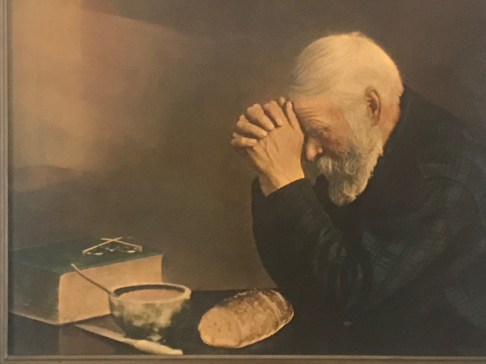
To help in that rumination, let me share with you one of my favorite (and famous) photographs, titled Grace.

Grace Picture


According to Wikipedia, the photograph is a shot taken in 1918 or perhaps 1920 (Note: Wikipedia also asserts the book in the photo is not a Bible, but a dictionary…a point which, if true, I choose to ignore).  This photograph hung as a print in my grandparents’ home, and thus I will always associate it with their steadfast love for Jesus…a love which took them often to prayer.

May the Lord bless and keep you in prayer tonight.

In Christ,

P.J.

“Who Calls the Shots?” – COVID Era Devotion, Day 30

Brothers and Sisters,

As followers of Christ who know the sovereign God of all creation, we rightly love to remind ourselves and each other that God is in control.  We do so often, and we should do so often.  In his mercy, God brings moments and seasons into our lives that test our belief in his sovereignty.  “Testing” is an important theme in Scripture; an important aspect of growth in the Christian life.  We need the times when it feels easy to say that God is sovereign – the sun is shining, the bank account feels stable, the car works okay, there’s food on the table, the kids are doing well, etc.  We also need the times when it feels like a difficult act of faith to say that God is sovereign – when we’re not allowed out in public together, and when our “freedom” to live normally seems dependent on government shelter-in-place orders.  Such times press us to search our hearts.  Who do we actually believe is “in control”?  What authority stands truly sovereign over not only the affairs of men and nations, but the affairs of our county, and the needs of our city?  Who holds the steering wheel in our daily lives?

Increasingly we’re beginning to hear talk of when, and how, the coronavirus restrictions will lift.  On the one hand, I’m heartened to read of some restrictions possibly being loosened by early May.  On the other hand, I’m at least concerned to hear of significant continuing restrictions for possibly months ahead.  As discussion begins to ramp up it’s coming, not surprisingly, with a clash of authorities.  The “who is sovereign” question figures prominently in our media at present.  President Trump asserts one thing, state governments another, and meanwhile county health officials continue their work apace.  Who’s to say what should or should not be (Note: Let’s not forget, as informed, faithful citizens, that constitutions and laws matter at this point)?  Praise God that we have an answer!  When will we as Jesus church be free to gather and meet once again?  Answer: Precisely when the Lord Jesus Christ says so!  The God-ordained powers that be will work through a process – for better and for worse – but the outcome of that process will accomplish God’s plan for his people – “The king’s heart is a stream of water in the hand of the LORD; he turns it wherever he will (Prov. 21:1). I trust that our governing authorities will allow us to meet again at the earliest point possible.  I will hope for and expect that outcome unless reality suggests otherwise.  No matter what, it is for us to live each-and-every God-given moment in humble dependence on him.

We can rest secure in what Paul said to the pagan occupants of Athens:

“And he [God] made from one man every nation of mankind to live on all the face of the earth, having determined allotted periods and the boundaries of their dwelling place, that they should seek God, and perhaps feel their way toward him and find him.  Yet he is actually not far from each one of us, for ‘In him we live and move and have our being’; as even some of your own poets have said, ‘For we are indeed his offspring.’  Being then God’s offspring, we ought not to think that the divine being is like gold or silver or stone, an image formed by the art and imagination of man.  The times of ignorance God overlooked, but now he commands all people everywhere to repent, because he has fixed a day on which he will judge the world in righteousness by a man whom he has appointed; and of this he has given assurance to all by raising him from the dead.” – Acts 17:26-31

Anticipating with you a day of freedom to come…

In Christ,

P.J.

“Silent, Sort of, Seismometers” – COVID Era Devotion, Day 29

Brothers and Sisters,

In listening to an episode of “The Briefing” podcast this morning, I heard Al Mohler (the host and president of The Southern Baptist Theological Seminary) make reference to a New York Times article titled: “Coronavirus Turns Urban Life’s Roar to Whisper on World’s Seismographs.”  The gist of the article is that “shelter-in-place” measures around the world have literally silenced humanity.  This silence reflects in the readings of seismometers all over the globe.  A seismometer is an instrument that records vibrations in the earth.  They’re used, as the article writes, “to detect earthquakes, but their mechanical ears hear so much more…Even the everyday hum of humanity – people moving about on cars, trains and planes – has a seismically detectable heartbeat.”  With our world’s response to the coronavirus, the human signature on seismometers is now measurably, even significantly, quieter than before.

As we reflect on a curiosity article like this one, it seems appropriate that the oddity of quieted seismometers would turn our attention to God’s Word:

Psalm 46:10 (ESV) – “Be still, and know that I am God.  I will be exalted among the nations, I will be exalted in the earth!” 

 Psalm 65:7-8a (ESV) – “By awesome deeds you answer us with righteousness, O God of our salvation, the hope of all the ends of the earth and of the farthest seas; the one who by his strength established the mountains, being girded with might; who stills the roaring of the seas, the roaring of their waves, the tumult of the peoples, so that those who dwell at the ends of the earth are in awe at your signs.”

 Habakkuk 2:20 (ESV) – “But the LORD is in his holy temple; let all the earth keep silence before him.”

In a special way, we’re experiencing these texts while we wait for coronavirus to pass.  Praise God that he will be glorified, come what may!

In Christ,

P.J.


“Anger and Bitterness?” – COVID Lockdown Devotion, Day 28

Brothers and Sisters,

Have you ever walked through a time when your perspective needed help; a time when you were tempted to be overwhelmed by bitterness and anger, even anger that seemed justified?  How does a right perspective on God meet us when we struggle to understand, interpret, and live well in our world, including with respect to the evil that manifests so often?  Well, consider Psalm 73 with me (all quotations come from the NASB translation).

The Psalm opens on a note of praise to God; to God who is “good to Israel, to those who are pure in heart!” (vs. 1).  But then, it quickly transitions into an autobiographical account of the Psalmist’s own struggle.  This man struggled deeply with bitterness and anger, especially as it pertained to his “envious” response toward the wicked:

“But as for me, my feet came close to stumbling, my steps had almost slipped.  For I was envious of the arrogant as I saw the prosperity of the wicked.  For there are no pains in their death, and their body is fat.  They are not in trouble as other men, nor are they plagued like mankind.  Therefore pride is their necklace; the garment of violence covers them.  Their eye bulges from fatness; the imaginations of their heart run riot.  They mock and wickedly speak of oppression; they speak from on high.  They have set their mouth against the heavens, and their tongue parades through the earth.  Therefore his people return to this place, and waters of abundance are drunk by them.  They say, ‘How does God know?  And is there knowledge with the Most High?’  Behold, these are the wicked; and always at ease, they have increased in wealth.” – Ps. 73:2-12

The Psalmist’s struggle over what he observed was so profound that he cynically wondered why he even bothered to live a holy life.  All it brought him was difficulty and heartache: “Surely in vain I have kept my heart pure and washed my hands in innocence; For I have been stricken all day long and chastened every morning” (vs. 13-14).  He was ready to “throw in the towel” on the God thing.  It simply wasn’t paying-off.

Over time, the anguish built up in this man’s soul.  Try as he might, his efforts to “understand this” proved fruitless.  They were “troublesome in [his] sight” (vs. 16).  Nothing changed until one crucial act.  Nothing changed, “Until I came into the sanctuary of God” (vs. 17a).  In that moment, everything changed.  What the Psalmist needed was not the fruit of his own distorted reasoning; not the logic of his own troubled soul.  He needed the presence of God and the Word of God.  When he entered into that presence, clarity came with a rush: “Then I perceived their [the oppressive wicked] end.  Surely you set them in slippery places; You cast them down to destruction.  How they are destroyed in a moment!  They are utterly swept away by sudden terrors!  Like a dream when one awakens, O Lord, when aroused, You will despise their form.”

And so, this man is thankful for God’s protection.  He realizes what it would have meant for him to walk away from truth in response to bitter, angry envy: “If I had said, ‘I will speak thus,’ Behold, I would have betrayed the generation of Your children” (vs. 15).  He realizes how close he came to becoming like those whose wickedness he so despised and bemoaned: “But as for me, my feet came close to stumbling, my steps had almost slipped” (vs. 2).

As his song ends, the Psalmist transitions from remembering bitter anger and envy into full-blown doxology (praise!).  He is full of praise both for who God is, and for God’s work to preserve him in the face of his own threatening sin:

“When my heart was embittered and I was pierced within, then I was senseless and ignorant; I was like a beast before You.  Nevertheless I am continually with You; you have taken hold of my right hand.  With Your counsel You will guide me, and afterward receive me to glory.  Whom have I in heaven but You?  And besides You, I desire nothing on earth.  My flesh and my heart may fail, but God is the strength of my heart and my portion forever.  For, behold, those who are far from You will perish; You have destroyed all those who are unfaithful to You.  But as for me, the nearness of God is my good; I have made the Lord God my refuge, that I may tell of all Your works.” – Ps. 73:21-28

Notice how God’s divine work to preserve this man came when the Psalmist himself was helpless and even lost: “When my heart was embittered and I was pierced within, then I was senseless and ignorant; I was like a beast before You” (vs. 21-22).  In other words, “I was helpless and sinful in my position before you!  I was like the arrogant and oppressive wicked ones!”  And yet, even as he wallowed in the middle of such unthinking nonsense, God met this man and rescued him.  God moved toward him.  God took hold of him.  God brought him into God’s own presence and showed him truth: “Nevertheless I am continually with You; You have taken hold of my right hand” (vs. 23).  Such an awesome salvation gives the Psalmist great confidence for the future: “With your counsel You will guide me, and afterward receive me to glory” (vs. 24).  How then can the Psalmist do anything but praise God (vs. 25-28), ending with the beautiful statement: I have made the Lord GOD my refuge, that I may tell of all Your works” (vs. 28)?

Do you struggle today with bitterness and anger, with envy and discontentment?  Do you ever wonder why you should bother with living a life that honors God as you follow Jesus?  What you need, what I need, is not better self-talk, or revenge, or “things to go our way for once.”  What we need is to come “into the sanctuary of God” in order to gain his perspective, to remember his love, and to experience his work to save us.  That sanctuary begins in a relationship with Jesus Christ, as we know him through the Bible, and it continues in our relationship with his body, the church.  Only there will our perspective become God’s perspective.  Only there will we understand the true nature and the real end of wickedness.  Only there will we realize our own wickedness and learn to rejoice in our Christ-accomplished salvation.  Only there will we find the contentment that can say: “My flesh and my heart may fail, but God is the strength of my heart and my portion forever” (vs. 26).

Love in Christ,

P.J.

“Resurrection Eve” – COVID Lockdown Devotion, Day 27

Brothers and Sisters,

As this Resurrection Sunday comes to a close, I hope you’ve been blessed with rest and a reminder of God…God in Christ loving, saving, and preserving you.  If you are a disciple of Jesus Christ, then know that he who saved you will also keep you and preserve you beyond death in this body.  Sunday has come…heaven awaits!

You can find the audio from today’s sermon available on the Felton Bible Church webpage.  For those who watched the live broadcast, you certainly noticed some volume issues.  We think those occurred due to our new broadcasting procedure.  Hopefully by next week we’ll have worked a solution.

I bid you goodnight and God bless!

In Christ,

P.J.

“Music for the Heart” – COVID Lockdown Devotion, Day 26

Brothers and Sisters,

The day after Jesus’ crucifixion must have been agonizingly difficult for his disciples.  Imagine the fear, the emptiness, the loss, the trauma, the anxiety.  I suppose it was a quiet time.  Perhaps you can relate to what they must have felt.  Tonight’s devotional is simply a series of links to five songs you can listen to on YouTube.  Let them minister to your heart as you prepare for Resurrection Sunday morning.  I look forward to celebrating with you the fact that Jesus Christ is a risen Savior!

“Stricken, Smitten, and Afflicted” – https://www.youtube.com/watch?v=x-QFx5RRqFM

(Mark especially this line: “Ye who think of sin but lightly, nor suppose the evil great; here may view its nature rightly, here it’s guilt may estimate.”)

“His Mercy is More” – https://www.youtube.com/watch?v=C-hD4VEoVQs

“Come Behold the Wondrous Mystery” – https://www.youtube.com/watch?v=C-hD4VEoVQs

“Christ is Risen” – https://www.youtube.com/watch?v=vBqPXvP6aso

“Is He Worthy?” – https://www.youtube.com/watch?v=OIahc83Kvp4 (or the live version from a conference last year: https://www.youtube.com/watch?v=DMWrAqMWhWs)

In Christ,

P.J.

“6-Ft Apart, Six-Feet Under” – COVID Lockdown Devotion, Day 25

Brothers and Sisters,

Have you noticed the great irony in our social distancing criteria?  Here’s what I mean…How far apart are we supposed to stay from others not in our immediate family unit?  Answer: 6ft.  Now, in what other context do we often think of a six-foot distance?  Answer: A grave.  We are buried “six-feet under,” or so the saying goes.  Ironically, this parallel is entirely appropriate.  We’ve died a death, of sorts, in the “shelter-in-place,” “social distancing” world that we inhabit today.  There’s sense in which we’re walking through an experience of the grave.

It’s highly apropos that we, the living, would taste some small measure of death as the clock ticks down on this Good Friday.  Today, we remember that Jesus died – he died on a cross under the crushing wrath of God in order to glorify his Father by saving undeserving sinners like us.  Jesus, literally, experienced Hell in that place called Golgotha.  He did this so that we who follow him by grace through faith will not undergo the same.  “For God so loved the world, that He gave his only begotten Son, that whoever believes in Him shall not perish, but have eternal life.  For God did not send the Son into the world to judge the world, but that the world might be saved through Him.  He who believes in Him is not judged; he who does not believe has been judged already, because he has not believed in the name of the only begotten Son of God” (John 3:16-18, NASB).

Tomb and Rolling stone Picture
A tomb and rolling stone seen from the roadside in Israel (circa 2016)

On the day of his crucifixion, Jesus was dead by about 3:00 pm and his body was buried before sundown.  In spirit he returned once again to the presence of the Father in heaven (Luke 23:44), but bodily Jesus entered a tomb belonging to Joseph of Arimathea (Luke 23:50-54).  As your Friday comes to a close, remember the cross.  As your Saturday begins to dawn, remember the grave.  Be helped by our moment of living death (not to be too dramatic, but it is six feet after all) to think and pray with a mind toward Jesus’ death and Jesus’ burial, all the while anticipating the joy that lies ahead.  Sunday’s coming…

In Christ,

P.J.

“Move Straight Ahead” – COVID Lockdown Devotion, Day 24

Brothers and Sisters,

Let’s continue in our devotional thoughts for this week to sit with the book of Joshua, once again building on yesterday.  Joshua chapters five and six recount Israel’s campaign against the city of Jericho, a “gateway” city, if you will, to the rest of the Promised Land.  In Joshua 5:13-6:5, Joshua encounters a messenger of Yahweh, described as “commander of the army of the LORD” (Joshua 5:14).  This angelic warrior (or, perhaps, maybe even a pre-incarnate appearance of Jesus) gives Joshua the battle plan for taking Jericho.  That plan involves marching around the city once on each of six days, and then seven times on a seventh day.  At the end of the seventh circuit on the seventh day, God commanded the following: “And when they [the priests] make a long blast with the ram’s horn [their trumpets], when you hear the sound of the trumpet, then all the people shall shout with a great shout, and the wall of the city will fall down flat, and the people shall go up, everyone straight before him” (Joshua 6:5, ESV).  If you skip ahead to chapter six, verses 15-21, that’s exactly what happened!

There is much that is fascinating about the account of Jericho, but I’m struck particularly by the phrase straight before him.  A quick word study (tied to the English Standard Version translation) shows that the Hebrew term here refers generally to that which is “opposite” a person, that which is “before” someone, that which is right in front.  When the walls came down, God meant for each warrior to enter the city by moving straight ahead.  Why?  Well, I guess I don’t know for sure, though I could postulate some reasons for this command.  For instance, moving straight ahead when Jericho’s walls collapsed would demonstrate the utter sufficiency of God’s work in bringing those walls down.  There would be no need for Israel’s army to search out an access point into the city, because God intended to lay Jericho wide open.  Each warrior moving “straight before him” would visually display the totality and perfection of God’s work to judge Jericho and exalt Israel.  Perhaps that’s part of the “why.”

Now, as interesting as the “why” question might be, I’m struck much more by the results of God’s command, especially with respect to the experience of each individual Israelite warrior.  When God dropped the walls of Jericho, he required that each warrior move straight ahead into the city.  This means that whatever each warrior faced in the city was uniquely prepared for him by God.  While each soldier labored to obey God’s command to destroy everything and everyone inside Jericho (a grave task indeed, see Joshua 6:17a, 21), by moving straight ahead in obedience to Yahweh he would encounter only that which Yahweh meant for him to do.  His task would be his task, tailored to him by the sovereign Lord of the universe.  He would be prepared to accomplish it, not in his strength, but in the Lord’s, and he could trust that he would face nothing God did not intend for him to face…if only he would obey and move straight before him.

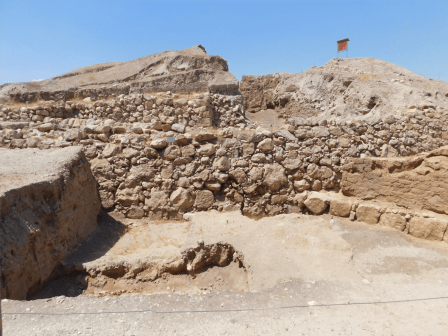
Jericho
A portion of Jericho’s ruins, circa 2016

Like yesterday, let’s bridge from the experience of an Israelite warrior assaulting Jericho to the experience of a Christian assaulting the gates of Hell.  To follow after Jesus is to walk a straight and narrow road (Matthew 7:13, Acts 13:10, Proverbs 3:5-6).  And, as we considered yesterday with Ephesians 6, that road often runs right into battle.  Yet, this need not be (should not be) any cause for fear on our part.  The God who commands us to go “straight before [us]” will not fail to prepare, in detail, for everything we’re going to face.  He will not leave us unequipped to victoriously encounter whatever lies ahead.  Consider how the Apostle Paul makes precisely this point in a slightly different context.  In Ephesians 2:8-10 (ESV), when writing of our salvation he says, “For by grace you have been saved through faith.  And this is not your own doing; it is the gift of God, not a result of works, so that no one may boast.  For we are his workmanship, created in Christ Jesus for good works, which God prepared beforehand, that we should walk in them.”  Following straight behind Jesus to assault the gates of Hell is a very good work indeed.  Let us then hear the charge given to Joshua by the commander of Yahweh’s hosts before the fortress of Jericho: “…the people shall go up, everyone straight before him.”

So, dear Christian, press on!  The battle lies ahead, and it is there that God means for you to be.  You have no armor on your back, only a breastplate, the breastplate of righteousness, the righteousness of Christ.  It will withstand any assault, and all the work that lies ahead is tailor-made for you by God himself.  The trumpet sounds…don’t stand waiting…

In Christ,

P.J.

“Disheartened and Disarmed!” – COVID Lockdown Devotion, Day 23

Brothers and Sisters,

I’d like to return to yesterday’s devotional and the account of Joshua leading Israel into the conquest of Canaan.  You’ll recall that we heard then about one of God’s mighty acts in Joshua’s time, namely the drying up of the Jordan River as the Israelites walked across.  That act had an immediate and devastating effect on Israel’s enemies.  We read this in Joshua 5:1 (NASB):

Now it came about when all the kings of the Amorites who were beyond the Jordan to the west, and all the kings of the Canaanites who were by the sea, heard how the LORD had dried up the waters of the Jordan before the sons of Israel until they crossed, that their hearts melted, and there was no spirit in them any longer because of the sons of Israel. 

Israel’s enemies – God’s enemies – grew fearful and dispirited when they heard about God’s mighty act at the Jordan River.  This was due in no small part to their prior knowledge of God’s work forty years earlier at the Red Sea with the Egyptians, and his work perhaps only months prior with the Amorite kings Sihon and Og (Joshua 2:8-11).  Now, with the Jordan drying up before Israel, the kings of the Amorites and the Canaanites saw that same hand of the Lord moving against them.  If you read the rest of Joshua, you’ll see how Israel is unstoppable (and unconquerable) when they walk in faithfulness after Yahweh according to his mighty acts.

What does this have to do with us?  Well, much, but only one point of which I’ll touch on here.  In yesterday’s devotional I likened the drying up of the Jordan to divine “child’s play” in comparison with God’s mighty act at the cross.  Consider then this thought: If God’s mighty act at the Jordan caused the hearts of Israel’s enemies to melt and their spirits to fail, then what must the far greater act at the cross do to the church’s enemies?  How must the cross affect the enemies who oppose Jesus’ followers?  Let’s be clear here.  When we say, “Enemies of the church,” we mean in particular Satan and his demons against whom we struggle.  Paul makes that quite apparent in Ephesians 6.  People may set themselves up as enemies of Christ, but we need not treat them as our own foes.  We can treat them (indeed, we must treat them) as precious creatures created in God’s image whose rebellion against their loving Creator desperately needs to end.  No, our struggle lies against the spiritual forces of wickedness in the heavenly places (Ephesians 6:12b, NASB).  So, what must God’s mighty act at the cross do to such enemies?  The answer can only be that it does to them what God’s mighty act at the Jordan did to the pagan kings and peoples of Canaan.  The cross must melt the hearts of our spiritual foes and cause their wicked spirit to quail in fear.  In fact, it did (and does) that and more!  Here’s how Paul puts it, speaking of what God did in and through Jesus’ death on the cross: When He [God] had disarmed the rulers and authorities, He made a public display of them, having triumphed over them through Him [Jesus](Colossians 2:15).  The words Paul uses here for “rulers” and “authorities” are the same terms that show up in Ephesians 6 when he speaks of demonic powers.  At the cross, God not only disheartened Satan and his minions, he disarmed them.

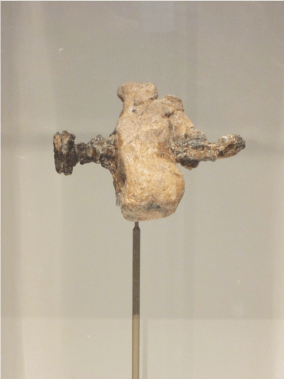
Heel Bone Picture
Remains found in a burial cave in north Jerusalem.  This is the right heel bone of a person killed by crucifixion.  Notice the iron nail that penetrates the bone.

So then, as followers of Jesus we battle a disheartened and disarmed enemy.  Praise God!  That doesn’t mean the battle isn’t and won’t be fierce.  Satan and his demons can still punch.  They can still deceive.  They can still bite, and claw, and kick.  But need that worry us?  We have access to God’s sword, his written Word, a double-edged sword that can meet any assault and expose any lie (Hebrews 4:12).  Like Israel of old, when we walk faithfully after Jesus according to God’s mighty acts, we are unbeatable.  Such confidence leaves us no excuse to not carry the fight into every dark corner of the globe, into every darkened heart, until everywhere God’s kingdom reigns supreme in the day of Christ Jesus.

Take up your sword this week, attentive first to your own heart, and battle well.

Love in Christ,

P.J.