
The Psalms are wonderful. Psalm 103 is particularly wonderful. Among the wonderful things David says in this poem are these words (verses 15-18, NASB):
(15) “As for man, his days are like grass;
As a flower of the field, so he flourishes.
(16) When the wind has passed over it, it is no more,
And its place acknowledges it no longer.
(17) But the lovingkindness of the LORD is from everlasting to everlasting on those who fear Him,
And His righteousness to children’s children,
(18) To those who keep His covenant
And remember His precepts to do them.”
Here’s a curious question: How can God’s eternal lovingkindness extend to man who is temporal? How can God’s lovingkindness be from everlasting (eternity past) to everlasting (eternity future) on those who fear him, if those who fear him are like grass that dies and is forgotten (vs. 15)? How is it that God loved me in eternity past before I existed? How will he love me in eternity future when my place in this world is like that of a dead and rotted flower?
In answer to these questions, let’s go two places in God’s Word, both with the Apostle Paul:
Ephesians 1:3-6 (Legacy Standard Bible) – “Blessed be the God and Father of our Lord Jesus Christ, who has blessed us with every spiritual blessing in the heavenly places in Christ, just as He chose us in Him before the foundation of the world, that we would be holy and blameless before Him in love, by predestining us to adoption as sons through Jesus Christ to Himself, according to the good pleasure of His will, to the praise of the glory of His grace, which He graciously bestowed on us in the Beloved.”
Romans 8:28-30 (LSB) – “And we know that for those who love God all things work together for good, for those who are called according to His purpose. Because those whom he foreknew, He also predestined to become conformed to the image of His Son, so that He would be the firstborn among many brothers; and those whom He predestined, He also called; and those whom He called, He also justified; and those whom He justified, He also glorified.”
God loved his people, he loved me, from everlasting (eternity past) in his work of election and predestination. From before the foundation of the world – from everlasting – God determined to save me, and not because of anything commendatory in me; quite the opposite (Ephesians 1). This determination of God brought me to a willing, and I pray growing, holy fear of him.
God will love his people, he will love me, to everlasting (eternity future) in his work of glorification. He’s promised to make me like his glorified Son, Jesus Christ. How? By uniting me to Christ through faith, and then transforming my heart into one that loves God even as Jesus loves his Father. Between this work of election and its end in glorification lie God’s acts of calling, justification, and sanctification, all the stuff of adoption.
Psalm 103:17-18 is a poetic rendition of saving grace. It is the doctrines of grace in song. It is the sovereignty of God in salvation rendered in the songs of Israel. Sovereignty pervades these words. It’s no surprise then that we have this statement in verse 19 (NASB): “The LORD has established His throne in the heavens, And his sovereignty rules over all.” The word translated here as “sovereignty” is a Hebrew term that refers to the ruling authority of a king. One source defines the word as, “sovereign power” (1). God is sovereign over all, and in that sovereignty he exercises his lovingkindness.
What happens when the song of Psalm 103 takes hold in a heart? David leaves us in no doubt: “Bless the LORD, O my soul…bless his holy name…Bless the LORD, O my soul…Bless the LORD, O you his angels…Bless the LORD, all his hosts…Bless the LORD, all his works…Bless the LORD, O my soul” (vs. 1, 2, 20, 21, 22, ESV). Seven times, bless the Lord! Notice that Paul agrees with David: “Blessed be the God and Father of our Lord Jesus Christ” (Ephesians 1:3). When the song of Psalm 103 takes hold, God’s people bless his name.
Bless the Lord, O my soul! May you too bless him today…
1. Theological Wordbook of the Old Testament, 1199.
Shaking Off the Dust
Last night I, along with others, supported by still others, had the opportunity to address the San Lorenzo Valley Unified School District (SLVUSD) Board of Trustees, in protest. We spoke in protest of the board’s unconscionable action to violate the religious conscience of students and families by inappropriately flying the so-called Pride Flag over our public-school campuses. This is not a new issue. My last post addressed the matter, as did many over the past four years.
My purpose in today’s post isn’t so much to focus on the experience of last night. If you’re interested, you can read my statement to the SLVUSD Board here. Rather, in this post I want to note how the Holy Spirit has framed the issue for me; and done so in what I expect is my last year addressing this particular board on this particular matter. To do this, I need to give you a little context regarding my regular time in the Bible. One of the things I imperfectly do with God’s Word is to continually and systematically read through the Psalms. I won’t elaborate on how for the moment, I’ll just point you to where this practice took me, both yesterday and today.
Yesterday’s song was Psalm 75 (NASB):
We give thanks to You, O God, we give thanks, for your name is near; Men declare your wondrous works. “When I select an appointed time, it is I who judge with equity. The earth and all who dwell in it melt; It is I who have firmly set its pillars. Selah. I said to the boastful, ‘Do not boast,’ and to the wicked, ‘Do not lift up the horn; Do not lift up your horn on high, do not speak with insolent pride.’” For not from the east, nor from the west, nor from the desert comes exaltation; But God is the Judge; He puts down one and exalts another. For a cup is in the hand of the LORD, and the wine foams; It is well mixed, and He pours out of this; Surely all the wicked of the earth must drain and drink down its dregs. But as for me, I will declare it forever; I will sing praises to the God of Jacob. And all the horns of the wicked He will cut off, but the horns of the righteous will be lifted up.
That was yesterday morning, as I contemplated going again to this board that has proved so hard-heartedly deaf to God’s people for four years. Do they know the foaming cup of God’s wrath that’s steadily filling against them? I want that question to land on me with holy trembling and holy thanks. The fact that I can receive Psalm 75:9 for myself owes nothing to me and everything to Christ. The men and women on the SLVUSD Board of Trustees need a Savior; one who’s already drunk God’s cup for them!
This morning’s song was Psalm 76. Here again is the text in its entirety (from the NASB):
God is known in Judah; His name is great in Israel. His tabernacle is in Salem; His dwelling place also is in Zion. There He broke the flaming arrows, the shield and the sword and the weapons of war. Selah. You are resplendent, more majestic than the mountains of prey. The stouthearted were plundered, they sank into sleep; And none of the warriors could use his hands. At Your rebuke, O God of Jacob, both rider and horse were cast into a dead sleep. You, even You, are to be feared; And who may stand in Your presence when once You are angry? You caused judgment to be heard from heaven; The earth feared and was still when God arose to judgment, to save all the humble of the earth. Selah. For the wrath of man shall praise You; with a remnant of wrath You will gird Yourself. Make vows to the LORD your God and fulfill them; Let all who are around Him bring gifts to Him who is to be feared. He will cut off the spirit of princes; He is feared by the kings of the earth.
Notice the theme of judgment, just as in Psalm 75. Notice the four times repetition of “feared.” The SLVUSD Board members don’t, seemingly, fear God. They fear man, not God. That’s a true but terrible thing to say. It’s terrible to say because God will arise in judgment, and on that day the whole earth will fear and be still. What will people do then who haven’t learned a holy fear of God – fear born of love – through Jesus Christ our Lord? In the day when God arises for judgment, you can either fear him in love, or you can fear him in terror. Which will it be for the six members (five elected, plus the district superintendent) of the SLVUSD Board of Trustees?
For four years I, and others, have labored to get the Board’s attention over the issue of the so-called Pride Flag. They’ve chosen to ignore us, repeatedly. Therefore, I think it’s time we obey the words of Jesus. Lord help me, I quote your words solemnly, not flippantly, sadly, not in triumphalism: “And if any place will not receive you and they will not listen to you, when you leave, shake off the dust that is on your feet as a testimony against them” (Mark 6:11).
Consider this post a shaking of the foot.
SLVUSD Violates Conscience
Today (May 6th) the so-called Pride Flag again went up over the public school campuses of the San Lorenzo Valley Unified School District (SLVUSD). The district took this action despite the fact that doing so once again violates the conscience of students in their care. There’s a history to this egregious, callous disregard for people of religious conviction, one that reaches back at least to 2021. If you’re new to the saga, please review the posts and associated material available here, here, here, here, and here (from most recent to oldest). As you do, know the immediate issue is not that of whose worldview wins – one shaped by biblical convictions, or one driven by the LGBTQ+ sexual revolution. Rather, the issue turns on what’s appropriate for educational authorities in a public-school setting.
Before I address Christian parents and educators in Santa Cruz County, let me note a few important points:
1. I first addressed the SLVUSD Board of Trustees on this matter in 2021, at which time I expressed my willingness for extended dialogue. In 2022 and 2023, I explicitly asked for such dialogue. The Board has refused. Why? I think they’re afraid. They’re afraid to engage the questions asked and the arguments raised. Why are they afraid? Maybe because they know it’s wrong to violate the convictions and conscience of students in pursuit of their agenda. I repeat my request to the SLVUSD Board of Trustees for a substantive dialogue over an important matter. I challenge them to prove their courage.
2. Today’s action came as something of a surprise. Not totally, because I expected the flags to go up at some point. This week of nonsensical disregard comes like clockwork each May since 2021. It was a surprise because in past years the Board always passed a resolution to fly the flag; one typically taken in April. A recent review of official documents showed nothing indicating the Board’s adoption of a similar resolution for 2024. When the flags went up today, I took a brief field trip to the SLVUSD District Office. There I discovered that a resolution was indeed passed, one to fly the flag annually “during the week leading up to the Annual Queer Youth Leadership Awards” (see SLVUSD Board Resolution 2023-24-04). The Board took this action on August 2, 2023. Why August 2nd? I don’t know. I’m inclined to think August was convenient for passing a controversial resolution. Who would see and notice something passed in August? Perhaps I’m wrong, but this looks like cowardice.
Now, let me address you reading this who follow Jesus Christ, fellowship in his church, and still have children in the Santa Cruz public school systems. If that’s you, I’m with you in the struggle of trying to faithfully educate your kids in the public schools. It’s no easy task. We need God’s help to be “wise as serpents and innocent as doves” (Matthew 10:16). That said, let me ask you this: Will you keep your children at school this week? Will you willingly let your kids walk onto their campus beneath a flag that makes a tyrannical, unholy demand on their allegiance? Don’t deceive yourself into thinking that isn’t happening. Did you know the Pride Flag is the creation of a man who openly mocked Jesus Christ by parading through the streets of San Francisco in his Pink Jesus costume (see here)? Will you, with evident protest, remove your children from school until next Monday?
Finally, to Christian educators in Santa Cruz’s public systems: Thank you for seeking to honor Christ in an amazingly difficult vocational context. You’re a breath of fresh air in a world that’s often stifling. But, for you too I have questions. Will you let a week like this pass unchallenged? Are you comfortable submitting quietly to the Pride Flag when you walk into work each day? Isn’t your conscience violated? Please stand up and open your mouth with courage. Go to your administration and make this an issue. Go to your Board and publicly object to this obvious disregard and disrespect. Do it to glorify Christ and do it as an act of loving service to the kids you teach. If you need an ally, let me know. I’d like to help in any way I can.
Nonsense prevails when people refuse to stand up and speak up.
Standing on the Brink of Faith
It’s a breathtaking, almost infuriating moment. The people of Israel were there, in Kadesh-barnea, on the cusp of blessing. A little more than a year after leaving 400 hundred years of slavery in Egypt, they were on the doorstep of Canaan. They were about to receive the next step in God’s covenant promise to Abraham. At God’s command, Moses sent spies into the land. The spies’ report was good, yet fearsome: “The land is rich, but it’s full of warriors whom we can’t face” (Num. 13:27-29). So said ten of the twelve men who spied out Canaan. Two said, “Let’s go! Yahweh is with us!” (Num. 13:30, 14:6-9). Rather than hear the two, Israel listened to the ten:
“Then all the congregation raised a loud cry, and the people wept that night. And all the people of Israel grumbled against Moses and Aaron. The whole congregation said to them, ‘Would that we had died in the land of Egypt! Or would that we had died in this wilderness! Why is the LORD bringing us into this land, to fall by the sword? Our wives and our little ones will become a prey. Would it not be better for us to go back to Egypt?’ And they said to one another, ‘Let us choose a leader and go back to Egypt’” (Num. 14:1-4).
This is Israel’s response after the plagues in Egypt…after deliverance across the sea…after the glory and terror of Sinai…after the manna…after the quail…and so on. They don’t doubt God’s reality (in a sense), but they doubt his goodness. They rebel against his rule.
As it was with Israel, so it always is in the fight of faith when sinful flesh rears its head. When faith requires that which seems risky en route to God’s blessing, fleshly faithlessness attacks the goodness of God. In anxiety, it catastrophizes (“They’ll kill us!”), reasoning as if God does not exist and is not faithful to his promises.
Ever found yourself on the brink of faith in your battles with the world, the flesh, and the devil?
Ever found yourself pining for the good old days of bondage; bondage to sinful patterns, to an easy life, to immature faith, to childish ways of thinking and living, etc.?
Ever found yourself wanting a return to Egypt because you’re not willing to risk everything on the premise that God is good?
Ever found yourself forgetting God’s track record of faithfulness in your life, not to mention across history itself?
“[We have not received] the spirit of slavery to fall back into fear, but [we have received the Spirit of adoption as sons, by whom we cry, ‘Abba! Father!’” (Rom. 8:15). When you find yourself standing on the brink of faith, take care against the temptation to doubt the goodness of God. Take refuge in God’s Word, and let your heart and your mouth cry, “Abba!” After that, press forward into the land of promise. Will God who began a good work in you, and for you, fail to finish his work (Phil. 1:6)? “He who calls you is faithful; he will surely do [according to his promise]” (1 Thess. 5:24).
Do You Know Mrs. Hutchings?
Do you know Mrs. Hutchings? I don’t, but I praise God for her! Did you know that decades ago she rendered an invaluable service to Jesus’ church? She exercised a simple gift that has, for almost sixty years now, blessed tens of thousands.
Perhaps you know of Dr. D. Martyn Lloyd-Jones. MLJ (as I’ll call him) preached and pastored in Wales, and then England, from the late 1920’s through to the late 1960’s. In God’s gracious providence, the Holy Spirit used his faithful, powerful preaching in mighty ways. MLJ’s ministry continues to resonate, not only through recordings of his sermons (which you can listen to via the MLJ trust), but also through his written works, which are largely his preached sermons put into books.
Among MLJ’s writings is one sermon-series-turned-book titled Spiritual Depression: Its Causes and Cures. This book is a precious work of pastoral counsel. I read it, very slowly, some years back. Time-after-time as I read MLJ’s words, it felt like I was sitting in the pew of Westminster Chapel, hearing him preach, and finding the Holy Spirit dealing with my soul.
This morning I picked up Spiritual Depression again and opened to the “Forward.” There I found the following statement written by MLJ in 1964: “All who may derive some help from them [the sermons that form the book] will want to join with me in thanking Mrs. Hutchings who originally took down the sermons in shorthand…” Who is Mrs. Hutchings? She was, I suppose, a simple, relatively unknown saint, who exercised a gift of shorthand to record the words MLJ preached that eventually became Spiritual Depression. How many thousands of Christians have been helped by her “simple” labor? Would anyone have thought her ability with shorthand a “spiritual gift” set to bless tens of thousands over decades? Probably not. But, in the sovereign purpose of God, that’s exactly what it was, and what it became. Praise God!
Brother or sister, what simple gift has God given to you? What abilities and opportunities has he entrusted to you, with which to serve and love others in Jesus’ name? Do those abilities and opportunities seem small and insignificant in your eyes or the eyes of others? Perhaps they are. But, doesn’t the God who fed thousands with five loaves of bread and two fish (Matthew 14:13-21) multiply simple gifts and small opportunities? Doesn’t he make them mighty in the kingdom of God?
Praise God for Mrs. Hutchings!
Responding to Political Evil
How should Christians respond to the political world in which we live, especially when that world trends toward evil? Recent discussion – for better and for worse – around “Christian nationalism” make this a fraught question. It will only become more fraught in 2024. Our national elections will ensure as much, helped by things like the dubious documentary slated for release this year. If you want to read a helpful article on Christian nationalism, consider this summary at American Reformer. If you want more, consider Dietrich Von Hildebrand.
Dietrich Von Hildebrand was a German Catholic philosopher of the mid-20th century. Von Hildebrand is known to history as one of the earliest, most public, and most vocal opponents of Adolph Hitler and Nazism. I learned of Von Hildebrand first from Eric Metaxas, and then from John Henry Crosby in My Battle Against Hitler: Defiance in the Shadow of the Third Reich. I’m going to quote at length from one of Von Hildebrand’s essays, published on March 10, 1935, during his several years living and writing in Austria (prior to the 1938 German takeover of that country, known as the Anschluss). I find his words, so relevant at the time, both prescient and helpful for Christians living some 90 years later. Of note, please don’t construe my quoting Von Hildebrand as a commendation of Catholic theology, the Roman Catholic Church, or the pope. When Von Hildebrand refers specifically to Catholics, insert “Christian,” and the relevance remains for a Protestant like me. Here then are words of Dietrich Von Hildebrand, as translated in My Battle Against Hitler (with my occasional editorial note in brackets):
In many Catholic circles…one encounters the view that the lesson to be learned from the defeat of political Catholicism in Germany is that Catholics should turn away from politics in order to concern themselves exclusively with religious matters and adopt a passive attitude toward political events. Indeed, one may sometimes hear even the clergy in Austria voice the opinion that one must already mentally adjust now to the possibility of a National Socialist [Nazi] regime and should be on one’s guard against cultivating excessively intimate ties with the present regime.
However, there is clearly something ambiguous about this call to depoliticize Catholicism and to concentrate solely on religious matters. When it entails a due regard for the primacy of the purely religious sphere, disavows an excessively intimate relationship between religion and party politics, and aims to put an end to the politicizing of religion, it is undoubtedly good and justified. The bankruptcy of political Catholicism in Germany does indeed teach us this lesson. But it is utterly impossible to expect Catholics to be indifferent to politics at a time when the debates in the political sphere concern not just political issues but…fundamental beliefs about the meaning of existence [like, for instance, life in the womb, or gender and sexuality, to name just a few].
When today the Antichrist is rearing his head in Bolshevism and National Socialism [or wokist Marxism and kinist protectionism], when Christ is persecuted with unprecedented hatred, and a revolt is raging not only against the sphere of the supernatural but even of the person in general [tell me again, what is a woman?], all Catholics must fight for Christ in the political sphere with full personal commitment, representing importune opportune (in season and out of season) the claims of the kingdom of God and thus, implicitly, those of morality and the natural law. They will feel called to this commitment to the extent that they live in Christ and see everything in the light of the supernatural, to the extent that they have interiorized their religious existence and are conscious of the primacy of the properly religious sphere as the unum necessarium (the one thing needful).
In a time when the state expressly advocates totalitarian claims and incessantly seeks to overstep its divinely ordained sphere of competence [2020 and COVID anyone?], indifference to the political sphere on the part of Catholics constitutes an outright desertion of duty. It is precisely the rootedness of genuine Catholics in a realm that transcends politics, their freedom from the inner dynamism of political practice, and their consideration of all things in conspectu Dei (before the face of God) that requires them to erect a dam against every encroachment of the state.
In point of fact, the real lesson to be learned from the bankruptcy of politicizing Catholicism is this: rather than politicizing Catholicism, one must instead Catholicize politics. For the human being is an integral whole, and true religiosity will inevitably induce him to regard all areas of life in their orientation to God and to work, always and everywhere, for the kingdom of Christ…This begins in one’s own person, in the induere Christum (putting on Christ)…it requires a commitment to Christ in the earthly public sphere and in political activity, in order that there, too, everything may be formed in the spirit of the natural law and of Christian teaching.
Naturally, the principal contribution of the Christian in this sphere is his personal transformation in Christ. But that must not be his only contribution. It is of course true that, for the Christian, the transformation of the face of the earth does not proceed primarily from without by means of laws of the state, but rather from within by means of the conversion of the person. Naturally, the Christian rejects every form of earthly messianism and remains ever aware of “how great is heaven and how small the earth.” Nevertheless, he makes use of all legitimate earthly means in order to shape the polis (the political community) in such a way that the kingdom of Christ may be built up within it.
Thus “Catholic Action”…is indeed apolitical in the sense that it must not be understood as a political party or engage in party politics itself; but it certainly extends into the political sphere, since Catholics who are active politically have the same obligation to carry the spirit of Christ into this domain that they have with regard to any other sphere of life. Anyone who does not admit this is not thinking as a Catholic but in the manner of pietistic quietism. This is undoubtedly a danger today…
Bolshevism and National Socialism are primarily worldviews [so also wokist Marxism and kinist protectionism]. They neither are, nor wish to be, mere political systems. Apathy toward the political sphere on the part of Catholics easily leads, therefore, to apathy toward National Socialism as a whole. Many say, “Why should we always simply attack and criticize? Let us depart from the political sphere; let us search out and convert those who have gone astray. Let us, who stand aloof from politics, spread the spirit of love and reconciliation.”
This is, at bottom, a cowardly flight from the battle to which God is calling us. It is our obligation as soldiers of Christ to wage war against the Antichrist and to rip the mask from his face. The “apolitical” disposition cultivated by certain Catholics, which induces others to refrain from exposing and relentlessly fighting against National Socialism, is an evil sophism. What is at stake in the position one adopts toward National Socialism as a whole…is nothing less than the question: Are you for Christ, or against Him?
Here too, Christ’s words hold true: “He who is not with me is against me” (Mt 12:30). The soldier of Christ is obligated to fight against sin and error. His battle against the Antichrist is prompted by his love for Christ and for the salvation of souls; he fights this battle for the salvation of those who have gone astray. His attitude is one of true love. But those who flee from the inevitable battle and treat irenically those who have gone astray, obfuscating their error and playing down their revolt against God are, fundamentally, victims of egoism and complacency.
Are these not challenging words for American Christians facing 2024? We’re not battling National Socialism, but let’s not forget that National Socialism had its beginnings, as did every political evil across time. How should we hear and apply Von Hildebrand’s exhortation in days to come? Therein lies important and fruitful discussion for people who love Jesus and love their neighbor.
North Star or Morning Star?

The picture you see here is significant. Let me explain why. This is the view you’ll have if you sit at the foot of the table in the Honor Board Room at the United States Air Force Academy and look up. To be clear, as a cadet you don’t ever want to experience this view. If you do, it’s because your integrity’s being questioned. It’s because you’re suspected of having violated the Honor Code, which says, “We will not lie, steal, or cheat, nor tolerate among us anyone who does.” The code is a bastion of cadet life. Its violation is the fastest way to find oneself dismissed from the Cadet Wing. Regrettably, there’s a deep irony to this picture, which I’ll get to in a moment.
The Honor Board Room resides within USAFA’s Polaris Hall, which houses the Academy’s Center for Character and Leadership Development (CCLD). Maybe you remember that Polaris is another name for the North Star. Polaris Hall is oriented toward the North Star. If you sit in the seat at the foot of the Honor Board conference table and look up, the building intentionally funnels your view toward the North Star. The symbolism is purposeful. If you’re here, it’s because your integrity is on trial. What’s your moral compass in this moment? What’s your moral north star?
Now, why is this ironic? It’s ironic because, like much of the moral fabric of American culture today, USAFA’s Honor Code is slowly eroding, and it’s doing so with official sanction. In today’s Air Force, you can don the uniform of a USAFA cadet, having taken the honor oath, and all the while deny your fundamental identity as a human being (see here). You can lie about your gender – man or woman – and your lie will receive not censure, but official sanction. A male cadet can deceitfully claim a female identity (or vice versa) and never have to answer for that lie with a view like the one here. Cheat on your math test…you’ll face this view. Lie about who you are as a person, and you’ll be congratulated for your authenticity.
What does this rumination tell us? It tells us the North Star isn’t a faithful moral compass. It’s not sturdy enough, permanent enough, or true enough. The North Star as a symbol helps us down the road of thinking that truth is objective; that there are moral absolutes which span time, space, and cultures, and thus bind all people everywhere. But, as USAFA so aptly demonstrates, the North Star can’t define the content of that truth, or the nature of these absolutes. We need not the North Star, but the Morning Star. We need the one who said, “I am the root and the descendant of David, the bright morning star” (Revelation 22:16b, ESV). We need, “…the prophetic word…to which [we] will do well to pay attention as to a lamp shining in a dark place, until the day dawns and the morning star rises in [our] hearts” (2 Peter 1:19, ESV). We need Jesus. Moral relativism makes foolish liars of all its adherents. It degrades a culture and weakens a nation. It takes honorable (if fearsome) words like, “We will not lie, steal, or cheat, nor tolerate among us anyone who does,” and turns them vacuous.
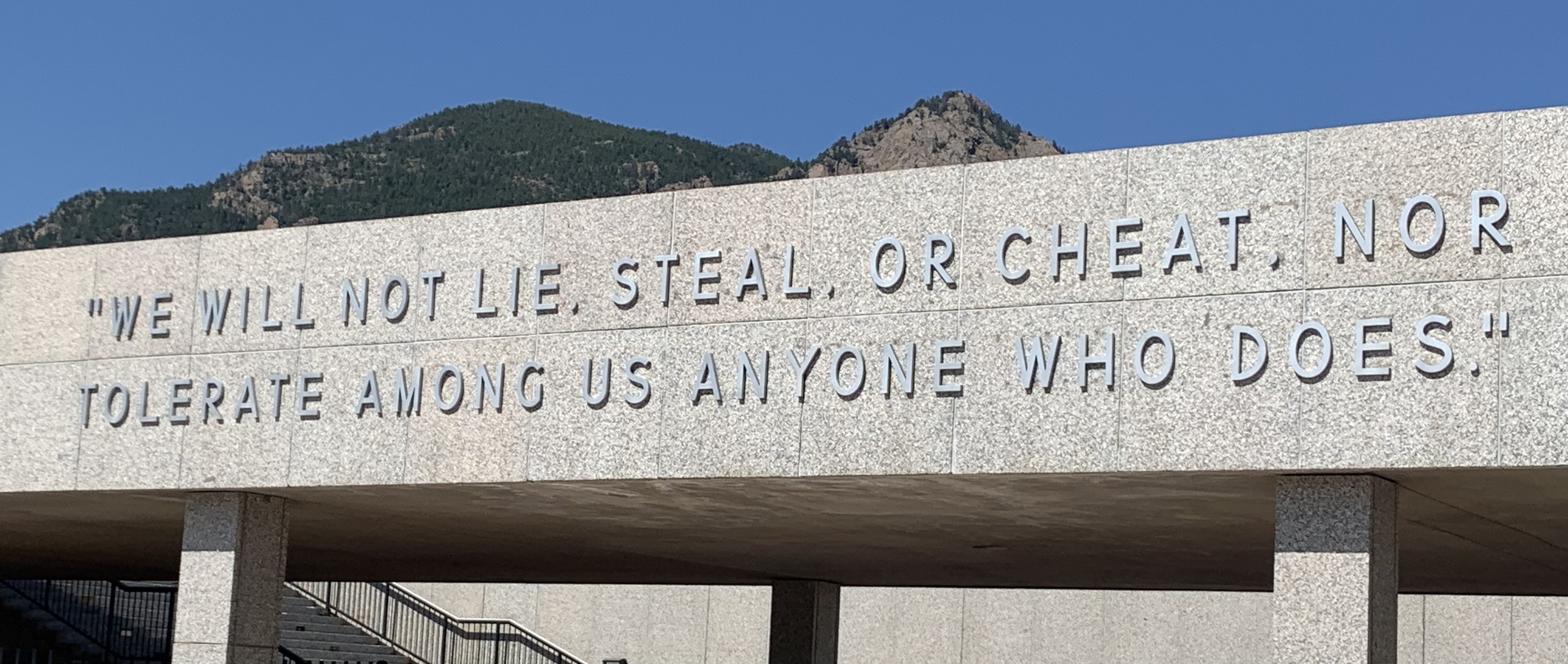
There’s a better table than the conference table in the Polaris Hall Honor Board Room. It’s a table of perfect integrity where redeemed liars sit clothed in truth. It is the banqueting table of the “…marriage supper of the Lamb” (Revelation 19:9, ESV). It is a table, not of judgment, but of grace. This table points, not north, but toward the Morning. Do you have a seat at this better table?
Hidden and Sheltered in Death
(This is the third of three recent posts. See the first two here and here.)
In reading Psalms recently, specifically Psalm 31, I’m reminded again that death is no final enemy for a Christian, a follower of Jesus.
In Psalm 31, which Jesus quoted at the cross, David writes this: “How great is Your goodness, Which you have stored up for those who fear You, Which You have wrought for those who take refuge in You, Before the sons of men! You hide them in the secret place of Your presence from the conspiracies of man; You keep them secretly in a shelter from the strife of tongues” (vs. 19-20, NASB).
Ask yourself, where, finally, is the secret place of God’s presence for the Christian? Is it not on the other side of death (or of Jesus’ return), in the immediate presence of Jesus Christ, unhindered by sin? Where is the unbreachable shelter that ultimately guards God’s people from the strife of tongues? Is it not on the other side of Bunyan’s dark river (to borrow an image from The Pilgrim’s Progress)? In paradise (Luke 23:43), Jesus Christ covers and protects his disciples until the time arrives for his manifest kingdom on earth. In this place of protection, the Christian fears no conspiracy; he (or she) experiences no assault of the tongue, and all the tongue brings with it. Death is, finally, no enemy for someone saved from death by the eternal Son of God.
Let me offer a quick case study by considering my Dad, killed by a reckless driver in May 2020. Since that time, think of all that Dad has been spared: the strife and governmental tyranny of the COVID era after May 2020; the nastiness of rioting in the summer of 2020; January 6, 2021, and all its fallout; the many immoral statements and actions of President Biden and Governor Newsom; the moral insanity of the California legislature; Russia’s cynical invasion of Ukraine; Hamas’ wicked assault on Israel and the tragic aftermath unfolding now…need I go on? Of course, all these things I’ve mentioned are “large scale” matters. I haven’t even touched the more personal difficulties Dad might have encountered, even difficult wrestling with his own sin. For more than three years now, he’s missed it all! He’s been covered and protected in the presence of his King, Jesus Christ.
Indeed, death is no enemy to those for whom its stinger has been plucked out (1 Corinthians 15:56)!
Saying, “I Love You,” to Another Man
(This is the second of two recent posts. See yesterday’s post here.)
One tragic consequence of the sexual revolution in which we find ourselves, a revolution largely defined by the acronym LGBTQ+, is, perhaps, the struggle for one man to say to another, “I love you.” It’s not that the words aren’t, or can’t be, spoken, but rather that we’re less apt to say them for fear of being misunderstood (whether in our own mind or otherwise). It’s not surprising that we might struggle in this way. In a world marked by open and increasing homosexuality, the words, “I love you,” between male counterparts, have been sadly hijacked.
To be clear, we ought not charge all our male reticence in speaking thus to one another against the sexual revolution. Even without this wholesale departure from God’s holiness, men are still less apt to verbally express love for another man, particularly another man of their same age and life-stage. In one sense, this reticence is wholly appropriate. It signifies the emotional and verbal differences between men and women, including in how we express ourselves. It also signifies the high regard we have for concepts and spheres of love. The way I love my wife is entirely different (though not fundamentally different) from the way I love another man. Thus, using the same term – “love” – in both cases sometimes feels a bit odd, though it need not.
All of this, the world around me and my own internal reticence, makes me thankful for men in my life who have, and are now, teaching me, and helping me, to say, “I love you,” to other men. I have in mind here men like my two grandfathers, or my father. I mean men like my three brothers, and them especially since my own father’s death in May 2020. I mean my brothers-in-law and my own son. I mean many brothers in Christ over the years who’ve demonstrated manly love for me, even if without using the phrase, “I love you.” These men have shepherded me, and they are shepherding me now, toward Christlike maturity in love; the sort of maturity that can come to another man and say, with holy honesty, “I love you.”
Why is this matter of love expressed to another man so important? Why is it, in fact, essential to my life and faith? It’s important because I desperately want to say, with all honesty, and with manly vehemence, “I love you,” to the truest man who ever lived. I want the God-Man, Jesus Christ, to hear from my lips, “I love you,” with no awkwardness, or reticence, or dissimulation. He saved me for this purpose. He loved me first for this purpose! I want the joy (perhaps the painful joy) of an exchange like this (see John 21:15-17, ESV):
Jesus: “P.J., son of Phil, do you love me more than these?”
PJ: “Yes, Lord; you know that I love you.”
Jesus: “Feed my lambs.”
Jesus: “P.J., son of Phil, do you love me?”
PJ: “Yes, Lord; you know that I love you.”
Jesus: “Tend my sheep.”
Jesus: “P.J., son of Phil, do you love me?”
PJ: “Lord, you know everything; you know that I love you.”
Jesus: “Feed my sheep.”
I’m thankful for the men who teach me to say, “I love you,” so that I can say the same to the One Man.
When God Hardens Hearts
The total and complete sovereignty of God. It’s a ringing theme of Scripture. God rules over all. Nothing lies outside his control. He ordains (he establishes, he decrees) all that is – all that has been, all that is now, and all that will be.
God is sovereign over our salvation and our sin.
God is not responsible for my sin, I am. But he is sovereign over it. He rules supreme over my every act of rebellion against him.
God is responsible for my salvation, I am not. I can do nothing to save myself. God must do it all. Within his work to save, I act in faith, but even this faith is first his gift to me.
Those whom God saves he softens (Ezekiel 11:19; 36:26-27). He regenerates them to new life, with a new heart; a heart not only able, but also ready, willing, and wanting, to obey the Gospel. Those whom God judges – those whom he does not save – he hardens. He confirms them in their sinful, culpable rebellion, not giving them new eyes to see and believe Jesus.
For the purposes of this post, I’m going to intentionally leave aside the difficult question of why God chooses some to save (some to soften) and leaves others to calcify in rebellion. It’s a question ultimately hidden in the sovereign purpose of God himself. I may not understand that purpose in full, but I know it’s good because I know God is good. Instead, I want to focus for a few paragraphs on the “how” of hardening. How does God confirm someone in their sin, ultimately to their destruction in Hell? How does he harden someone in rebellion against him? It’s an important question, in part because the answer helps us again see human responsibility, or human culpability, for our hard-hearted sin, even as God himself is totally sovereign over that sin. In other words, studying how God hardens the sinner helps me, in some small measure, to understand the interface between God’s sovereignty and volitional human personhood. Understanding how God hardens a sinner in their sin helps me see that God is not unjust or capricious in confirming someone all the way to final damnation in Hell.
In order to understand this process of divinely wrought calcification, let’s turn our attention to the Bible’s most famous case of a sinner being hardened, Pharaoh. I mean here the pharaoh before whom Moses and Aaron appeared, demanding that he let God’s people go free from Egypt (see Exodus 5). In case you’re interested, I think it’s highly likely that the Pharaoh in question was Amenhotep II (see Expedition Bible video here). But, his specific identity isn’t Scripture’s concern. What is Scripture’s concern is the way God dealt with this proud, wicked human potentate.
In Exodus 4:21 (ESV), Yahweh says this to Moses: “When you go back to Egypt, see that you do before Pharaoh all the miracles that I have put in your power. But I will harden his heart so that he will not let the people go.” Notice I’ve underlined the word “all.” God wants to ensure that Pharaoh sees all his mighty miracles entrusted to Moses. He can’t miss even one…not one. Why? Because this full-spectrum revelation will leave Pharaoh totally and completely without excuse in his hard-hearted rebellion against God. God will harden Pharaoh’s heart by revelation, by progressively showing himself and his power to this wicked king. As Pharaoh rejects Yahweh, time-after-time, he will progressively confirm the rejection of God for which he is culpable, responsible, guilty. Even when the last straw falls and God kills all the firstborn of Egypt – human and “livestock” – even then Pharaoh’s acquiescence to God will only be temporary (Exodus 12:29, ESV). Even after a decisive, unmistakable revelation of God’s power and authority, Pharaoh will still turn and say: “What is this we have done, that we have let Israel go from serving us?” (Exodus 14:5, ESV). The point is this, God does not harden Pharaoh’s heart by hiding himself from Pharaoh, but rather through clear, compelling, and powerful revelation that Pharaoh rejects. Why does Pharaoh reject it? Because he’s a sinner. He loves his sin, and in his sovereign, righteous, good determination, God leaves Pharaoh to calcify in rebellion all the way to final damnation.
What happens to Pharaoh is instructive. It teaches us. As God worked with Pharaoh, so it is with every sinner who, in God’s sovereign purpose, does not repent. No one will ever stand before the throne of God for judgment and justly charge God with injustice for leaving them ignorant of his glory and goodness. Every sinner will finally be damned based on their knowledgeable rejection of God who reveals himself. Consider Romans 1:18-21 (ESV):
“For the wrath of God is revealed from heaven against all ungodliness and unrighteousness of men, who by their unrighteousness suppress the truth. For what can be known about God is plain to them, because God has shown it to them. For his invisible attributes, namely, his eternal power and divine nature, have been clearly perceived, ever since the creation of the world, in the things that have been made. So they are without excuse. For although they knew God, they did not honor him as God or give thanks to him, but they became futile in their thinking, and their foolish hearts were darkened.”
God does not hide himself; he reveals himself. The more God reveals himself for rejection by a sinner, the more confirmed that sinner is in their rebellion; the more calcified their dead, stony heart becomes – stage-by-stage, step-by-step, layer-by-layer. It’s frightening, horrific, tragic. Increased hardness comes with the rejection of increased, and increasingly clear, revelation. Notice what happens in Revelation 16:9, as the clear and compelling wrath of God works itself out on earth. Notice how people respond to the judging discipline of God: “…they cursed the name of God who had power over these plagues. They did not repent and give him glory.” Horrific hard-heartedness!
Dear reader, where has God revealed himself to you? How has he shown you his goodness and glory? Don’t reject the revelation! Receive it unto salvation, through faith in Jesus Christ as God the Son who died on a cross to save you from the power of sin, and from the wrath of God. May your heart not be calcified but softened.
 Fix Your Mind