
I recently listened to a talk given by Mike Kruger (of Reformed Theological Seminary) titled “The Dynamic Ministry of Women in Early Christianity.” It was delivered as part of The Gospel Coalition’s 2018 Women’s Conference (click the title above to access TGC’s webpage and find the recording). If you have 45 minutes or so and you’d like to be encouraged about the ministry of women in Jesus’ church, then this is well worth your time.
Category: Uncategorized
Eat and Ride…the Tour de France or the Christian Life
Recently my wife and I watched a rather interesting six-part documentary titled: Eat, Race, Win. It’s a dual storyline sort of account; one that traces both the experience of a high-end cycling team during the 104thTour de France, and the experience of their small but high-caliber food support team (Note: You only need the first 42 second of this video).
Watching, you get a sense of how the team’s riding flows from its feeding. A good Tour de France team-chef serves up food calculated to meet the team’s needs at each stage of the race. He or she is not merely a deliverer of culinary wonders, but also a student of both the athletes and the race itself. Interestingly, quality matters greatly, and not just for snooty reasons of high-end athletics. Rather, the team-chef strives to serve food the cyclists WANT to eat because they NEED to eat it…and a lot of it…think something like 5,000-6,000 calories daily. Quality food helps to increase the athletes’ desire for the high capacity consumption so essential to their success.
It strikes me that there is a certain parallel here with the preaching and teaching of Scripture in Jesus’ church. The Christian life is something like a bicycle marathon – with all the highs and lows, peaks and valleys, speed and danger, exhilaration and grinding endurance of a Tour de France. To ride this race, we as believers burn incalculable spiritual energy. As a result, we routinely need high calorie meals consisting of the food that is God’s Word. Riding our race without God’s Word is like trying to finish the Tour de France while starving. Though each of us can and should feed on that Word for ourselves, self-feeding ultimately won’t suffice. Rather, in order to gain all the calories necessary, we also NEED to hear God’s Word preached and taught in corporate worship. When it comes to the mealtime of worship, our ability to feed well depends greatly on the quality of the meal served. Of course, the quality of the ingredients is never in question – indeed, who could do better than the organic, unadulterated speech of God himself? But, fashioning those ingredients into a meal that we WANT to consume (even if, at times, that want is less a matter desire and more a matter of commitment) needs the services of a committed chef; a chef who can take the raw material of the Word and expertly fashion it into an unbeatable meal specific to each of us as riders in our individual stages of the Tour de Christian Life (okay…that last play on words is a bit corny…I know).
Praise God that we come to feast in worship under the care of the Master Chef par excellence…namely the Holy Spirit; he of whom Jesus said: “…the Helper, the Holy Spirit, whom the Father will send in my name, he will teach you all things and bring to your remembrance all that I have said to you…” (John 14:26)…and…“He [the Spirit] will glorify me, for he will take what is mine and declare it to you…” (John 16:14). The Spirit of God makes of God’s Word a rich, tasty, irresistible meal, guaranteed to fuel us just right for every stage of our race. If we sometimes resist eating all that he prepares (the vegetables perhaps), then it only makes us arrogant and unwise competitors. When the Chef serves up a meal it behooves us to actually come to the table, and then not to rise until we’ve scarfed up every last crumb. After all, who wants to bike the next stage on an empty stomach?
Now, where do Christian preachers and teachers fit in; the gifted elder-pastors and others to whom the Spirit entrusts the preparation and actual serving of his meal? Well, they are the sous-chefs. They are the ones who labor in the kitchen under the Chef’s direction and, when the time is right, bring out the meal the Chef intends to serve. To be a sous-chef in the Spirit’s kitchen is a glorious thing, particularly because his sous-chefs are also riders privileged to eat of the final product. Of course, this role is only one of many on the wider team. The athletes need more than just the food service folks to finish their race! Still, for those with a heart to cook, nothing beats the opportunity to chop a few carrots and sear a few steaks in preparation for another team meal!
Disturbing But Important
This link will take you to Albert Mohler’s daily podcast, “The Briefing“. Listen to the entry for 16 Aug 18, especially the first 13 minutes or so. This first segment of today’s program is particularly disturbing, but quite important. I’m encouraged by remembering these words from Jesus in Luke 6:22-23: “Blessed are you when people hate you and when they exclude you and revile you and spur your name as evil, on account of the Son of Man! Rejoice in that day, and leap for joy, for behold, your reward is great in heaven; for so their fathers did to the prophets.” The encouragement continues as I read the following from Paul, in 1 Thessalonians 3:3b-4: “For you yourselves know that we are destined for this [i.e. to endure suffering and tribulation for the name of Jesus]. For when we were with you, we kept telling you beforehand that we were to suffer affliction, just as it has come to pass and just as you know.” May our brother Jack Phillips endure with Jesus-centered, Paul-like joy!
Excellent 10-Min Video: Solomon’s Temple
Hey all, I just viewed a 10 min video that I think is incredibly well done and absolutely worth your time. It describes (with excellent animation) the structure and meaning of Solomon’s Temple, as we know it from Scripture. You can watch it here. Again, this one is worth watching…

The Swastika: A Truly Evil Symbol?
Recently, while reading a National Geographic History article titled, “Portraits from the Past: The Faces of Al Fayyum,” I came across a fascinating picture (1). The article describes funerary “portraits” used in the burial of mummies at Al Fayyum, Egypt “from the first century B.C. through to the fourth century A.D.” These masks were employed during a time when “Egyptian, Greek, and Roman styles and customs began to intertwine…” One of the images depicted in the article is a work called the “Tondo of the Two Brothers,” a copy of which I found posted on Pinterest:
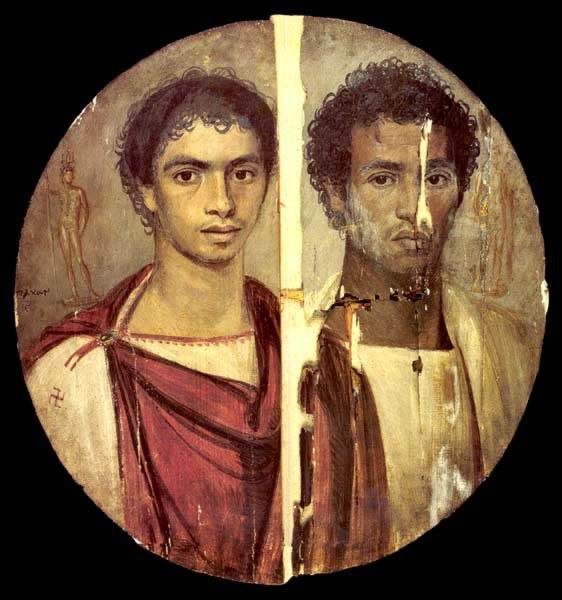
Do you notice something about the upper right arm of the left-hand figure? He bears a small red swastika. Seeing this reminded me about my curiosity over this symbol, its origins, and its meaning. If you grew up as I did – a child of the latter 20th century in Western society – then the swastika has one overriding connotation: the evils of Nazi Germany. But, perhaps you’ve also encountered the swastika in a context very different than anything apparently related to Nazi Germany. Consider for instance this picture, taken at a Buddhist temple on the island of Guam in 2012:

Similarly, the swastika shows up on another Buddhist statue, this time located at a museum in Beijing in 2011, and again as a candle arrangement at a Beijing location during the same year:


Being otherwise uninformed as to the history and origins of the swastika, it became clear to me over the years that the meaning of this symbol runs much deeper than mid-20th century Europe. This week I finally sat down to do a bit of cursory research. Maybe you’re way ahead of me in this regard, but for those that aren’t, here’s what I found:
The swastika is an old, old symbol, its origins obscured in the days of unwritten history. It is especially tied to Asian religious systems, including Hinduism and Buddhism, but not exclusively so (Note: The word “swastika” derives from a Sanskrit term. Sanskrit is an ancient Indian language) (2). In fact, one of the oldest known swastika patterns appears on an ancient ivory figurine found in Ukraine and housed today at the National Museum of Ukraine (see this BBC article titled, “How the world loved the swastika – until Hitler stole it”).
The origins of the swastika are difficult to ascertain because the symbol is so ubiquitous in so many different cultural contexts. The aforementioned BBC article states that the swastika “was used by the Ancient Greeks, Celts, and Anglo-Saxons…” Another source refers to the swastika being “found everywhere from monuments to the Greek goddess Artemis to representations of Brahma and Buddha and at Native American sites…” (see “The Man Who Brought the Swastika to Germany, and How the Nazis Stole It,” Smithsonian Magazine). It was even found in 1,800 different variations amongst the ancient ruins of Troy (“The Man Who Brought the Swastika to Germany, and How the Nazis Stole It”). Thomas Wilson, curator for the Department of Prehistoric Anthropology of the U.S. National Museum, wrote this in an 1894 report: “The first appearance of the Swastika was apparently in the Orient, precisely in what country it is impossible to say, but probably in central and southeastern Asia among the forerunners or predecessors of the Bramins [a Hindu caste] and Buddhists. At all events, a religious and symbolic signification was attributed to it by the earliest known peoples of these localities.”
As to its meaning, the limited and unscholarly sources I reviewed agree that the swastika historically symbolized blessing or good fortune. From a more scholarly viewpoint, Thomas Wilson states: “What seems to have been at all times an attribute of the Swastika is its character as a charm or amulet, as a sign of benediction, blessing, long life, good fortune, good luck. This character has continued into modern times, and while the Swastika is recognized as holy and sacred by at least one Buddhistic religious sect, it is still used by the common people of India, China, and Japan as a sign of long life, good wishes, and good fortune).” The Jewish Virtual Library notes, “Throughout its history the swastika represented life, sun, power, strength and good luck.” Again, in Wilson we read this: “…it would seem that, except among the Buddhists and early Christians, and the more or less sacred ceremonies of the North American Indians, all pretense of the holy or sacred character of the swastika should be given up, and it should (still with these exceptions) be considered as a charm, amulet, token of good luck or good fortune, or as an ornament for decoration.” In short, until the middle of the 20th century most people viewed the swastika as a positive sign – sometimes of religious significance – with almost universal application.
In summary then, before I offer some further thoughts, the swastika is a widespread ancient symbol, sometimes religious, and seemingly as old as human history. Although varied in terms of specific meaning, the swastika historically pointed to life, vitality, good fortune, and perhaps the sun itself.
Now, let me see if I can make two points that seem to me quite pressing with respect to the swastika. First, may I suggest that this symbol indicates a common origin for human beings? How else does one design acquire such widespread, transcultural significance with an apparently positive meaning that holds stable across time? It would seem that the swastika arose early in human history. Perhaps this symbol traveled from Babel outward in the days when God scattered his human creation by confusing their language (see Genesis 11:1-9).
Second, despite positive connotations, it seems that almost from its inception darkness has lurked just below the surface of the swastika’s lines. Think about it…Here we have a widespread and compelling symbol representing “good” and the “good life” usually apart from reference to the one true God. This is especially true if the swastika did in fact originate with early animistic Hinduism before being subsumed into Buddhism. The swastika has, apparently, represented life, vitality, good fortune, and blessing in a way not dependent on God. Isn’t that the great temptation in the Garden as the serpent says to Eve: “You will not surely die. For God knows that when you eat of it [the fruit] your eyes will be opened, and you will be like God, knowing good and evil” (Genesis 3:4-5)? Isn’t the desire to prosper apart from God simply a manifestation of the pride that undergirds humanity’s rebellion (sin) against our Creator? And doesn’t human sin sit right near the core of evil, perhaps one degree removed from the evil that is Satan himself? Do you see my point? Do you see how even the positive connotations of the swastika form only a veneer over that which is fundamentally corrupt and dark?
(Note: By way of an interesting sidebar, if it is legitimate to see a connection between the swastika and the sun, then the symbol reminds us of this warning from Deuteronomy 4:19: “And beware lest you raise your eyes to heaven, and when you see the sun and the moon and the stars, all the host of heaven, you be drawn away and bow down to them and serve them, things that the Lord your God has allotted to all the peoples under the whole heaven.”)
Now, if I am correct to associate the swastika with a desire for good apart from God, if I am correct to see evil just below its surface, then it’s really no surprise that this symbol presided over perhaps the greatest physical manifestation of evil in the 20th century – namely Hitler, the Nazis, and their Holocaust. Hitler did not turn the symbolism of the swastika evil, he merely completed its logic. The Nazis drew out and accentuated what was already incipient, or latent, or implicit in the history of the form itself. A symbol innocuously impregnated with the meaning of “good” apart from God became a harbinger of terror when its surface veneer cracked.
I don’t want to suggest here that all manifestations of the swastika in history are irretrievably evil. Indeed, by definition anything that points to that which is actually “good” necessarily points to God, though the pointer may not know it. This is why, perhaps, even early Christians were able to make use of the swastika motif. While the symbol itself is likely irredeemable in Western culture post Nazi Germany, the swastika motif as a matter of geometric design may yet find use in a God-honoring fashion – perhaps when Jesus returns and sets all things right.
Instead of bashing the swastika as manifestly evil, my real point is to peek just underneath the surface-level meaning of the design. It is to notice the incipient evil that lies lurking when “good” is disconnected from “God.” This basic point leads me to two conclusions (maybe points of application) that need brief mention before I close this post:
Conclusion #1: Anytime I look for “good” (blessing, good fortune, life, vitality) apart from God, anytime I desire blessing in life apart from the person and work of Jesus Christ, I stand on a foundation that is fundamentally unstable and corrupted. No wonder that Scripture describes all my own attempts at righteousness as “filthy rags” (or a “polluted garment”; see Isaiah 64:6)! Yes, I am meant to desire the “good” life, especially the “good” that is life itself, vitality, and blessing. But none of this will make any ultimate sense separated from God himself; God revealed in the person and work of Jesus Christ; God as the definition and arbiter of “good.” Indeed, the pursuit of “good” apart from God will quickly lead down dark, twisted, and dangerous pathways. If my pursuit does not lead me to personally manifest Holocaust-like evil, it won’t be because I’m not on the road the same road traveled by Hitler and his henchmen.
Conclusion #2: For believers in Jesus Christ, the story of the swastika presents a challenge. Where in life do we unconsciously, or as a matter of unthinking sinful habit, give ourselves to something that is “good” with no reference to God, even in the symbols we esteem, honor, and make use of? In the area of California where I live, there is a highly expensive resort-type location that employs a solitary Cypress tree as its logo. The logo implicitly stands for wealth, leisure, refinement, golf, fine living, and luxury. Interestingly, this meaning isn’t too far removed from the historic connotations of the swastika. Seems innocuous right? What’s wrong with a Christian appreciating such things and enjoying some luxury in life? Maybe nothing…or maybe everything. The question is, as a professed disciple of the Christ, how does the worship of a poor, beaten, bloody, and crucified Jesus undergird my association with the Cypress and my identification with the logo? Am I enjoying that which seems “good” in worship of him who is GOOD, or is the Cypress truly alone in my mind and behavior, with no reference to God? If the latter case is true, then the Cypress might as well be a swastika.
(1) Eva Subias Pascual, “Portraits from the Past: The Faces of Al Fayyum,” National Geographic History, July/August 2018.
(2) Thomas Wilson, The Swastika: The Earliest Known Symbol, and its Migrations with Observations on the Migration of Certain Industries in Prehistoric Times (Washington: Government Printing Office, 1896), available at http://www.gutenberg.org/files/40812/40812-h/40812-h.htm#Page_952;
Memorial Day: Celebrating Imperfect Sacrifice
In light of the Memorial Day celebrations, I’m reposting something I initially wrote as a note for Facebook last year. May your day be a blessed time of remembrance and rest:
How does one think about and celebrate Memorial Day in light of the Gospel? On a day that remembers those who “gave” their lives in service to this country, how does one think about such sacrifice in light of God’s word? On the one hand, the question is a bit asinine. It’s in vogue these days to question everything, especially anything that seems too pregnant with patriotism or pro-Americanism. On the other hand, the question is exactly the sort a Christian ought to ask. Because we live as God’s people in a strange land, as sojourners whose true citizenship lies in heaven, then we ought to consider how to rightly engage the ceremonies and memorials of a passing temporal kingdom.
If it ever was “impersonal” for me, Memorial Day ceased to be so in 2007. That was the year I deployed to northern Iraq, and the names from that time stay with me; not as a burden, but certainly as a memory. They include Ryan Balmer and Matt Kuglics, two men who died in Kirkuk, Iraq on 5 Jun 07. They include Dave Weiger and Nate Schuldheiss, who both perished in November 2007 near Balad Air Base, Iraq. Finally, I also remember Derek Dobogai, an Army captain who died along with thirteen others, also nearby Kirkuk, Iraq. More than most, these names remain etched in my memory; men whose lives intersected mine in one fashion or another (albeit in relatively tangential ways), and who, ten years ago, paid the final price in service of their country.
How then do I think about such sacrifice? Not all sacrifice is inherently good. With the exception of the God-man himself, Jesus, even the most altruistic of human action finds itself corrupted by human pride. Indeed, Scripture makes it clear that sacrifice apart from the worship of God is an abomination: “The sacrifice of the wicked is an abomination to the Lord, but the prayer of the upright is his delight…The sacrifice of the wicked is an abomination, how much more when he brings it with evil intent!” (Proverbs 15:8, 21:27). This is strong language indeed. If wickedness encompasses anything inherently opposed to God, then how should I think about those whose “ultimate sacrifice” of their lives – even in service to their country – occurred as they stood in opposition to their Creator?
And yet, along with language like this, we also hear the Bible encouraging us to acknowledge the good even of imperfect sacrifice. We hear Jesus say things like: “Greater love has no one than this, that one lay down his life for his friends” – John 15:13 (Note: While this statement foreshadows Jesus’ own sacrifice a few chapters forward in John, his statement suggests something profound in any similar act of self-sacrificial love). We hear stories of the Roman centurion whose Godward philanthropy benefited the Jews (Luke 7:3-5). We may even remember the sacrifice of others gladly entered into on our behalf – like a man in southwestern Saudi Arabia sitting in an airport who once directed a clearly “fish-out-of-water” stranger (namely me) toward his flight. In short, life is complicated, particularly when one tries to understand the tangled depths of humanity and its sin nature. Praise God for his wisdom that far surpasses our own!
So then, in light of this complexity, let me offer a few thoughts on how we might think well on Memorial Day:
I can be thankful that it is not mine to judge the heart of another – Rather, I can honor and rejoice over sacrifice that is prima facie “good,” leaving the ultimate judgment of any such act to the wisdom of Jesus.
I can mourn sin that makes the sacrifice of a life necessary, even as I praise God that his justice has, and will, triumph– The fact that we have a day like Memorial Day is a somber reminder of the consequences of sin.
I can remember that even warfare can be a good, holy (dare I say it), and sanctified endeavor, particularly when undertaken by a believer in submission to King Jesus – Undoubtedly this statement requires further unpacking that I won’t attempt here. Suffice it to say, it is right and good that some should study, train, and prepare for difficult service on the battlefield, even service unto death.
I can rejoice over the ways in which the character of God shines through even in sub-standard sacrifice – Laying down one’s life on behalf of another points backward to the cross, whether the one sacrificing realizes it or not.
I can let the Memorial Day of a temporal kingdom raise to mind a cross at Golgotha – Memorial Day in the present is a shadow reminder of the cross-bound memorial God’s people will celebrate for eternity.
I can be thankful for the ways in which sacrifice accomplishes the sovereign purpose of God – God works through sacrifice, often despite the mindset of the one sacrificing. I am thankful that no life is wasted in the unfolding of God’s sovereign purpose for his creation.
I can be thankful for the way in which sacrifices recalled on Memorial Day served to restrain evil – Flawed though they were, the sacrifices I remember on Memorial Day – certainly those noted above – served to restrain great evil. For that I am thankful.
Yes, Memorial Day is a complicated holiday, and our celebration of it must be similarly complicated. But nonetheless it is a day worthy of note, because what it calls to mind is worthy of honor. So, I honor and am grateful for the sacrifice of men like Ryan Balmer, Matt Kuglics, Dave Weiger, Nate Schuldheiss, and Derek Dobogai. May their families this season find the comfort of salvation in the Prince of Peace.
The First and Last Step of Obedient Discipleship
A friend of mine and I were talking today about his 5-month old son and the ever-present lack of rest in their household at the moment. Like most infants, this budding man has yet to learn the obedience and the discipline of sleep. Sure, sleep is “natural” to a point, but not all that natural. If you’ve ever cared for a young child, you understand this point quite well. Children aren’t born knowing how to sleep through the night. It’s something that is learned, especially through the first baby-steps of parental discipline.
As we talked, it struck me…Learning to “rest” is the first act of obedient discipleship in response to God – in response to how he has created our bodies to work; in response to the authorities he has placed in our lives; in response to his sovereign care and keeping. The first step of submitting our wills begins as an “unthinking” (I say that tongue-in-cheek) infant who learns to rest through the night. Ironically, learning to “rest” is also, essentially, the last and greatest act of obedient discipleship to God. We learn to rest through adulthood, into old age, and even into death itself – to rest in God’s justifying and sanctifying work on our behalf; to rest in God’s plan for each day; to rest in God’s sovereign ordination of each stage in our life, come what may. We begin life learning to rest, and we end life learning to rest. I suppose this shouldn’t be any great surprise. After all, Adam and Eve’s rebellion against God was a defiant act of “doing” when they should have been “resting.”
In a manner of speaking then, discipleship in the footsteps of Jesus means learning to love and embrace Psalm 46:10 – Be still, and know that I am God. I will be exalted among the nations, I will be exalted in the earth!
Oh Lord, teach me to rest!
Jesus Was God Long Before Nicaea!
Jesus Was God Long Before Nicaea!: Another Cool Point from Archaeology
Did you know that the earliest Christians worshipped Jesus as God? Did you know that they did so long before the “church,” at the Council of Nicaea in A.D. 325, first formally articulated its view as to Jesus’ divinity? I realize my opening sentence here might sound like an elementary statement to many (particularly since we see such worship clearly demonstrated in the New Testament), but one skeptical charge against Christianity suggests that the church didn’t view Jesus as God until nearly 300 years after its founding. Recently I watched episode #3 of “Digging for Truth,” a half-hour program created by the Associates for Biblical Research. The first segment of this episode discusses a mosaic uncovered in Israel that clearly demonstrates Christians’ pre-Nicaea understanding of Jesus as God. Take nine minutes and watch this (see link above). I think you’ll be edified by the experience.
Thinking About Racism
Of all the various “issue-based” conversations current in the broader evangelical church in America today, it seems that race, racism, and racial equality remain front-and-center. For instance, this year’s Evangelical Free Church in America (EFCA) Theology Conference had much to say about these issues. To the degree that I’ve observed, listened to, or participated in the conversation surrounding race, I’ve found it difficult to engage well. Beyond the fact that I certainly wrestle with my own sin, human-finitude, and blind-spots, I also wrestle with frustration over the way in which discussion often proceeds. I won’t try to unpack here all of what I mean by “frustration.” If you’re curious, let’s talk in person. Instead, what I’d like to do is point you to a very helpful summary article by Kevin DeYoung, posted this morning on the Gospel Coalition website: “Racial Reconciliation: What We (Mostly, Almost) All Agree On, and What We (Likely) Still Don’t Agree On.” I really appreciate how DeYoung reviews and frames the multiple issues and questions at stake. His approach helps me to better articulate some of my frustration for the way in which the conversation seems to flow at times. It also encourages me that my concerns and questions are not mine alone. Finally, DeYoung does an excellent job of reminding me that questions of race, racism, racial equality, and racial reconciliation are real, important, and pertinent to the church at this moment in history. I wonder what Jesus is doing by leading us, his flock, into this conversation at this point in time. What is he preparing us for? How do we need to strengthen relationships, tear down walls, and build bridges for work that lies ahead?
Jesus in Ancient History
Among the early extra-biblical historical sources that mention Jesus Christ, a particularly fascinating example is a reference in the writings of the 1st century Jewish historian, Flavius Josephus (Note: Josephus was a hesitant leader in the A.D. 66-70 Jewish uprising against Roman rule. In A.D. 67, the Romans defeated forces under Josephus in Galilee, whereupon this former military man wisely changed careers. He eventually became a historian sympathetic to his captors. The work I reference below is my source for all the biographical details in this post):
“Now, there was about this time Jesus, a wise man, if it be lawful to call him a man, for he was a doer of wonderful works – a teacher of such men as receive the truth with pleasure. He drew over to him many of the Jews, and many of the Gentiles. He was [the] Christ; and when Pilate, at the suggestion of the principal men amongst us, had condemned him to the cross, those that loved him at the first did not forsake him, for he appeared to them alive again the third day, as the divine prophets had foretold these and ten thousand other wonderful things concerning him; and the tribe of Christians, so named from him, are not extinct to this day.” [Antiquities 18.3.3, in William Whiston, trans., The Works of Josephus (Peabody, MA: Hendrickson, 1987), 480.]
This one paragraph provides a stunning account of what Josephus (who was not a Christian) knew concerning Jesus. Consider this:
- Josephus knew the bare facts of the Gospel – Jesus lived, Jesus died, Jesus lived again.
- Josephus, by recording the basic storyline in an uncontested manner, confirms the historical context that we read in the Gospels – 1) Jesus undertook a public ministry that gathered Jews and Gentiles alike; 2) Pontius Pilate crucified Jesus at the instigation of the Jewish leaders.
- Josephus understood the Christian witness of Jesus as God’s Messiah and the fulfiller of Old Testament prophecy.
- Josephus apparently knew that Jesus’ followers believed him to be more than a mere man (Note: Observe this historian’s caveat, “if it be lawful to call him a man”). Notice how a non-Christian reflects the Christian belief concerning Jesus’ divinity long before the Nicene Creeds of A.D. 325 and A.D. 383.
- Josephus knew of accounts concerning Jesus’ miracles.
- Josephus attests to the fact that Jesus’ message was not exclusive to Jews only. Indeed, the transcultural applicability of the Gospel is a prominent theme in the New Testament (see the Gospel of Luke for instance).
In other words, Josephus knew much of Christian truth even before, or right as, the New Testament coalesced into its eventual canonical form. This suggests acute awareness by Josephus both of Christian oral tradition, and Christian writings. Perhaps the fact that he lived his writing days in Rome gave Josephus (who died circa A.D. 100) access to much of what became the finalized Bible. Certainly, he learned a great deal from the witness of Christians in the Roman church.
Regardless of how he learned what he learned, this one paragraph from Josephus is a remarkable witness to what the Christian church believed about Jesus from its very beginning!
He is risen! He is risen indeed!
 Fix Your Mind